English| EUR
Suggested for you
More currencies
Choose a language
Lake Titicaca sits at 3,812 meters above sea level, straddling the Peru-Bolivia border with deep-blue water and scattered island communities. Visiting the lake requires coordinating boat departures from Puno, altitude preparation, and multi-stop transit across open water. This guide structures a two-day visit that covers the Uros floating islands and Taquile's highland trails without rushing the crossings.
Quick answer
A Lake Titicaca 2 day itinerary typically dedicates day one to the Uros floating islands and day two to Taquile Island, with departures from Puerto de Puno beginning at 07:00. Boats depart Av. Titicaca in Puno, and combined community entrance fees total approximately 13 PEN. Early morning departures between 07:00–09:00 avoid midday crowds and allow sufficient transit time, as Taquile lies 35 kilometers offshore and requires a three-hour crossing each direction.
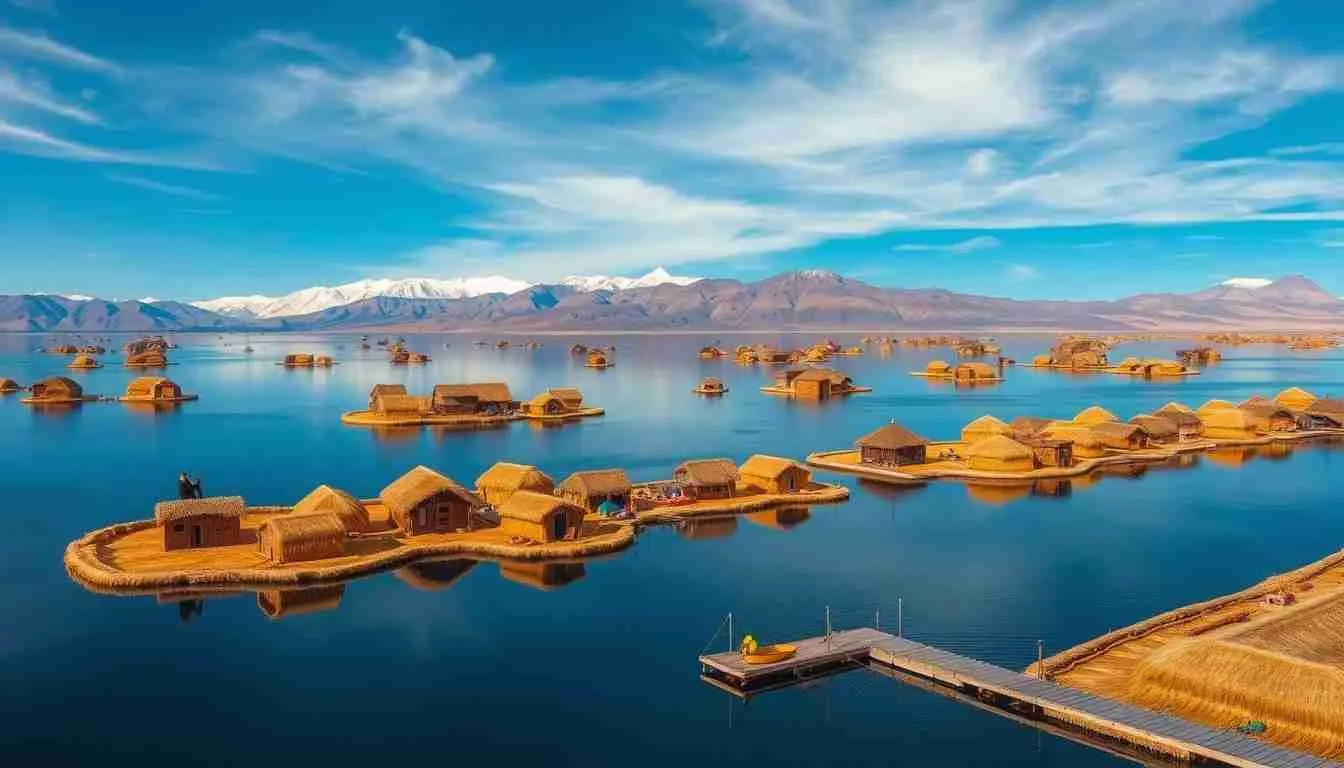
Lake Titicaca spans 8,372 square kilometers, making it South America's largest lake by volume and the highest navigable body of water on the planet. The vastness creates logistical challenges: island communities sit hours apart by motorboat, altitude compounds fatigue, and weather shifts rapidly across open water. A lake Titicaca 2 day itinerary solves the distance problem by splitting the two most-visited islands across consecutive days, preventing the exhaustion that comes from attempting both in a single crossing. Day one focuses on the Uros floating islands, a cluster of approximately 60 reed platforms anchored three kilometers offshore from Puno. The totora reed structures require regular rebuilding, and families demonstrate the layering technique that keeps the islands afloat. Visitors walk carefully across the spongy surfaces, and the visit lasts one to two hours before boats return to Puno. The proximity allows a relaxed morning departure and an afternoon return, leaving time to adjust to the 3,812-meter elevation that leaves many travelers short of breath on arrival. Day two extends to Taquile Island, a 5.72-square-kilometer outcrop 35 kilometers from Puno where Quechua-speaking communities maintain terraced agriculture and textile cooperatives. The three-hour boat crossing departs early—most operators leave the Puerto de Puno dock between 07:00 and 08:00—and the island itself requires stamina. A stone staircase climbs 567 steps from the dock to the main plaza, and trails connecting weaving collectives and viewpoints total several kilometers of walking at altitude. The return crossing departs mid-afternoon, arriving back in Puno by early evening. Two-day schedules also accommodate rest. Single-day island-hopping tours compress Uros, Amantani, and Taquile into one exhausting loop, often departing before dawn and returning after dark. Spreading the visits across two mornings preserves energy for the altitude, allows time to eat in Puno between excursions, and reduces the risk of altitude sickness that escalates with exertion. Travelers arriving in Puno from Cusco or Lima should ideally spend one night adjusting before beginning the lake itinerary, though many operators run tours starting the morning after arrival. Combined entrance fees for Uros and Taquile total approximately 13 PEN, paid in cash to community representatives on each island. Boats depart from Puerto de Puno along Av. Titicaca, where ticket kiosks line the waterfront and captains call destinations as passengers board.
“The vastness creates logistical challenges: island communities sit hours apart by motorboat, altitude compounds fatigue, and weather shifts rapidly across open water.”
This two-day plan suits travelers wanting to experience both the floating Uros islands and a traditional highland community with an overnight homestay. It balances transit time, cultural immersion, and flexibility for independent exploration.
Board a shared boat from Puerto de Puno to the Uros floating reed islands. The crossing takes 30 minutes; arrive early to secure a seat and avoid midday heat.
Spend an hour on the reed platforms, then transfer to a slower boat bound for Amantani Island—a 2.5-hour journey across open water.
Meet your host family on Amantani, settle into your room, and take lunch. The afternoon is free to hike to Pachatata or Pachamama temple viewpoints before sunset.
Share a meal with your family, often followed by traditional music or a community gathering. Nights on the island are cold; bring warm layers.
After breakfast, catch a mid-morning boat to Taquile Island—roughly 1.5 hours southeast. Taquile's stone paths and textile cooperatives reward a slow walk.
Eat at a family-run restaurant on the main plaza, then explore the island's terraced hillsides and weaving workshops. Allow two hours before your return boat.
Board the afternoon boat back to Puno, arriving around 17:30. The return journey offers wide views of the Cordillera Real as the light softens.
Use the evening to rest, eat at a local quinoa restaurant, or walk the malecón along the lakeshore before your onward journey.
The most effective planning window for a two-day itinerary is the dry season, specifically between April and October. To manage local transit, visitors must adhere to the best arrival window of 07:00–09:00 to avoid mid-day crowds and ensure sufficient time for boat transit to the islands.
Clear skies, 15°C to 18°C
This period offers the most consistent conditions for boat travel between islands.
Frequent rain, 12°C to 15°C
Expect localized disruptions and heavier cloud cover during this time.
—
Arriving during the 07:00–09:00 window minimizes congestion at the docks and boarding areas.
Verdict: The optimal period is Tuesday to Thursday during the dry season, utilizing the 07:00–09:00 arrival window.
The starting point for a two-day excursion on Lake Titicaca is the Puerto de Puno, located at Av. Titicaca, Puno, Peru. Visitors must utilize organized boat transport from this port to reach the islands.
Direct transit to Puerto de Puno, Av. Titicaca
Local routes to Puno center followed by a walk to the port
Walking from Puno city center to the waterfront
Organized transit from Puerto de Puno to the islands
Plan your arrival to the port within the best arrival window of 07:00–09:00. This timing avoids mid-day crowds and ensures sufficient time for your scheduled boat transit to the islands.
The access point for Lake Titicaca at Puerto de Puno maintains consistent operational availability throughout the week to support travel logistics. Visitors can access the port and local transit services daily.
Pack these essentials and handle logistics in advance to make the most of your two-day visit to Lake Titicaca.
Everything you need to know about lake.titicaca 2 day itinerary
A typical lake.titicaca 2 day itinerary usually includes overnight stays on Amantaní or Taquile to experience local homestays. You will also visit the Uros floating islands and observe the traditional customs of the highland communities. Balancing boat travel with island exploration is key to a successful plan.
Yes, a two-day Puno island excursion is the standard way to see the main attractions without rushing. You can visit the reed islands on the first day and continue to the larger ancestral islands for a second day of cultural immersion. This pace allows for better acclimatization to the high altitude.
Yes, there is a combined approximate community entrance fee of 13 PEN for the Uros and Taquile islands. Visitors should carry this amount in local currency to facilitate access to these specific areas. These community-collected fees support the ongoing maintenance and preservation of the sites.
The best arrival window is 07:00–09:00 to avoid mid-day crowds and ensure you have sufficient time for boat transit to the islands. Arriving early helps secure your spot on local transport and maximizes your daylight hours on the water. This timing is essential for staying on track with your lake.titicaca 2 day itinerary.
Boat transit is the primary mode of travel between the port and the islands throughout your journey. Schedules depend on group sizes and water conditions, so it is best to coordinate with local boatmen at the pier. Reliable transit ensures your visit remains efficient and stress-free.
Absolutely, the Uros floating islands are almost always the first stop on a lake.titicaca 2 day itinerary before heading further into the lake. Spending time with the Uros people provides insight into their unique architecture and reliance on totora reeds. It serves as a perfect introduction to the history of the basin.
The most common mistake is failing to account for the high altitude, which can impact your energy levels during a two-day trip. It is also a mistake to arrive late, as this often leads to missed boat departures and shortened island visits. Proper planning helps avoid these logistical issues during your stay.